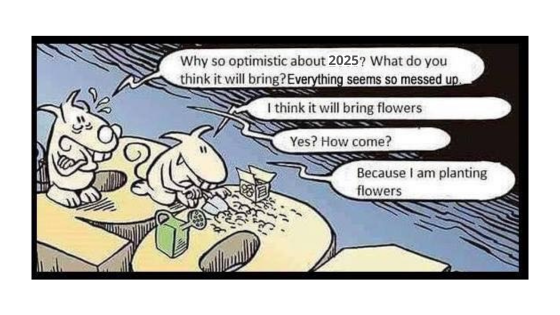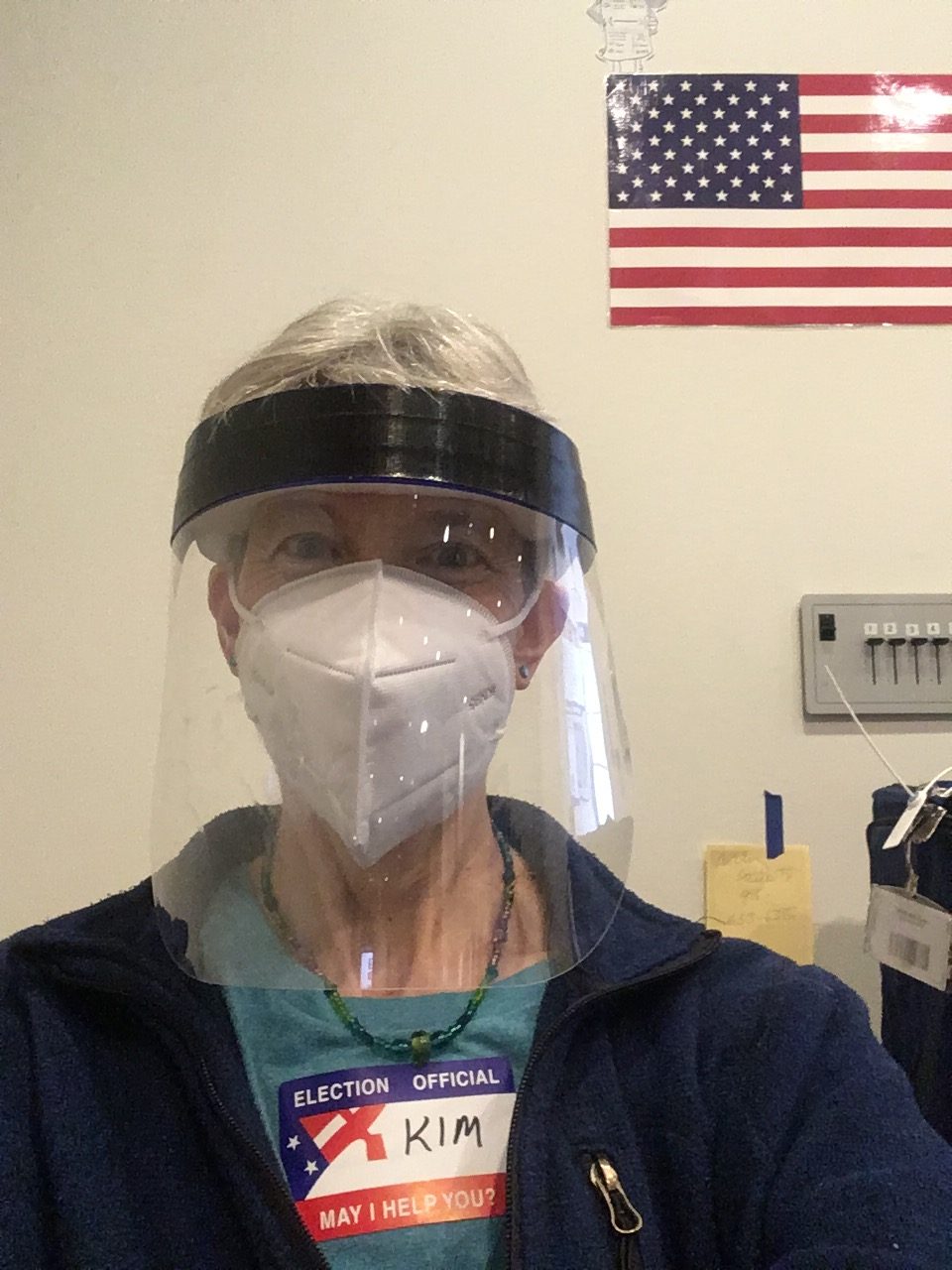

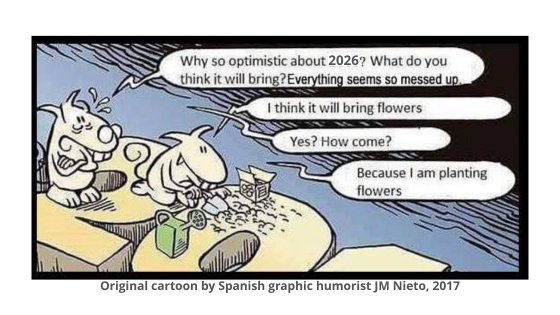
The above cartoon brings up many profound truths: It’s up to us; start small; little things matter; don’t give up; expectations are everything; be the change we want to see in the world; it’s always worth nurturing or creating something.
Of course, it’s not always that simple to plant flowers (literally or metaphorically). It’s easy to get paralyzed by thinking that whatever we do won’t be enough. I know I get caught up in that. I’m only one person; what can I do? Does it really matter?
This reminds me of the starfish story—one you may have heard me tell before. A storm strands thousands of starfish on the beach. A child walks along, picking up starfish and throwing them back into the sea, knowing they won’t otherwise survive. A passerby observes, “There’s so many, you’ll hardly make a difference.” The child pauses and replies, “But I’ll make a difference to this one.”
In some versions of the story, the passerby—inspired—joins in, and others follow until all the starfish have been safely returned to the ocean. This illustrates how any of us can lead by example, even if we don’t hold an important position or boast millions of social media followers—we just need to do the right thing.
Which as always raises the question of, “What is the right thing?” Last year I wrote that I believed we were in the middle of an unprecedented crisis. I still do, and if anything, it is only deepening. Some of you may know exactly what I’m referring to; others may not. Which brings me to Bad Bunny.
I’d never heard of Bad Bunny beyond his name and knew nothing about his music. He was irrelevant to my daily life: I’m not Latina, not Puerto Rican, not particularly on top of pop culture. But of course, if you are any of those things, your response would be, “HOW COULD YOU NOT KNOW WHO BAD BUNNY IS?!?!?”
I think it’s the same in politics, where those who follow the news (no matter the degree of their obsession), are flabbergasted that so many people in the United States either have no idea or don’t care what is going on in the halls of Congress, or at the Supreme Court, or with the presidency (in any era, not just now).
That doesn’t make them bad people, just as my ignorance of Bad Bunny doesn’t reflect on my character. We are interested in things that have meaning to us, and for many folks, politics doesn’t make the cut. It feels removed from our day-to-day lives and especially if you’re just trying to survive, there’s not a lot of attention span left for something that feels so disconnected.
But then something happens that sparks curiosity. In my case, I heard Bad Bunny won the Grammy for best album, and then my housemate shared a post in response to folks angry about him being the halftime entertainment at the Super Bowl, saying he should go home to his country. The post was pointing out that Puerto Rico, home to Benito Antonio Martínez Ocasio (aka Bad Bunny), is not a country but an American territory, meaning he is a U.S. citizen.
That ignited my interest so I did a little research, listened to some of his songs (they’re fun) and enjoyed watching the halftime show. As a result, I now know much more about his life and motivations, the Puerto Rican struggle for resources and recognition, and why his show was so meaningful for many Latinos in this country. It can be the same way with politics—there needs to be something that makes it personal. And there needs to be an invitation to learn, not scorn or shame if you don’t already know.
If I had been scorned or shamed for not knowing about Bad Bunny I probably would have doubled down and decided I would have nothing to do with him. But I think too often that’s what we do when we encounter people who don’t have the same interest or knowledge about things we take for granted. If we wish them to share that interest or knowledge, then we must be welcoming!
It’s also not a big leap to start disparaging others for daring to believe something different. I think we’re in a situation that has gone way past our typical two-party system divides, and instead the question we currently face is whether we are able to continue the American experiment with democracy. But if I hate you and think you’re stupid for disagreeing with me, and you hate me and think the same thing, we’re never going to get anywhere. None of us are going to change our minds if we’re being demonized. We have to open up our ears and our hearts to each other, especially those on the “other side.”
I recently listened to a podcast with Ezra Klein and James Talarico—Talarico is a former high school teacher from Texas turned state representative who is running for the Senate. He’s also a seminary student. I don’t share his religious beliefs, but I do agree with him 100% that we must shift from a politics of hate to a politics of love. Because only then—and it may not be enough, but we must try—is there a way forward that brings us together without tearing families and our country apart. Bad Bunny’s messages in the halftime show underscored this point: “The only thing more powerful than hate is love,” and “Together, we are America.”
So, if you have any friends or family members who disagree with you, or are clueless about Bad Bunny, let them know you still love them, okay? And for anyone who needs a bit of encouragement, remember this message Bad Bunny shared on the field:
“Mi nombre es Benito Antonio Martínez Ocasio, y si hoy estoy aquí en el Super Bowl 60, es porque nunca, nunca dejé de creer en mí. Tú también deberías de creer en ti. Vales más de lo que piensas. Confía en mí.” (Forbes.com)
Translation: “My name is Benito Antonio Martínez Ocasio, and if I’m here today at Super Bowl 60, it’s because I never, ever stopped believing in myself. You should also believe in yourself. You’re worth more than you think. Trust me.”
For more information click below:
- Bad Bunny’s life and work (Biography.com)
- Cultural references in Bad Bunny’s halftime show (Forbes.com)
- Interview between Ezra Klein and James Talarico (NYTimes.com)
********************************************************************
 Organizations like Braver Angels continue to do important work related to a politics of love, by creating spaces for people across political divides to genuinely listen to each other with curiosity and respect.